THC Beverages: The Category Everyone Wants to Win, Now Operating on a 12-Month Countdown Clock
By Jason Gotcher | BevOpsLogic
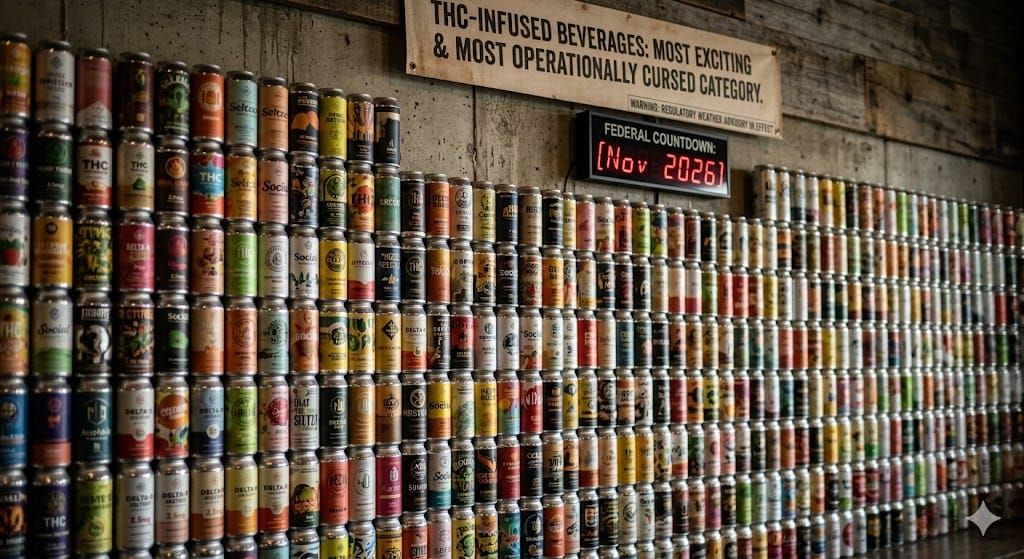
Let's call it: THC-infused beverages are the most exciting and most operationally cursed category in the drinks industry right now. Everyone's piling in. The federal government just started a stopwatch on most of them.
Here's what's actually working, what's actively failing, and the regulatory weather report, which got a lot more interesting in the last 90 days.
What's Working
Low-dose, session-able formats. The brands moving real volume aren't selling "get blasted in a can", they're selling the alcohol replacement use case. Friday night, two beers' worth of buzz, no hangover, no calories. Cans of THC-infused seltzer have become a lifeline at craft breweries as alcohol sales have declined in recent years. That's the pitch. That's the buyer.
Hemp-derived Delta-9 in beverage format, sold through liquor and grocery channels. This is the loophole everyone's been exploiting and it's been working, for now. The 2018 Farm Bill created a hemp lane, and clever formulators figured out you can hit a legal dose in a 12oz can if you keep the math right. Minnesota made infused beverages and foods legal in 2022 for adults 21 and older, and the products have become so popular that Target now offers THC drinks at some of its stores in the state.
Distribution partnerships with beer wholesalers. Brands that figured out THC beverages are a beer-adjacent SKU, not a cannabis SKU, are eating. The brands trying to sell through dispensaries only are capped at a fraction of the addressable market.
What's Not Working
High-dose hero products. These are getting hammered. Regulators don't like them, retailers won't shelf them, and the actual consumer for a high-dose beverage is already a regular cannabis user who'd rather buy a gummy. Some hemp-based beverages have been found to contain 30 milligrams or more of THC, more than a dozen times the intoxicating content of a can of beer, and those products are exactly what regulators are now targeting.
Cannabis-brand line extensions. Big dispensary brands trying to extend into beverage are getting humbled. Beverage is a co-packing, logistics, and shelf-velocity game. Cannabis operators built for vertical retail are getting their teeth kicked in on COGS and distribution.
"Functional" stacks (THC + adaptogens + nootropics + electrolytes). Consumers don't want a chemistry set. They want a buzz they can predict.
Sub-scale brands without co-packer relationships. This is the silent killer. THC beverage co-packing capacity is brutally tight. If you don't have a slot locked, you don't have a brand, you have a deck.
The Regulatory Weather Report, And Yes, It Just Changed
Here's the headline you may have missed: the federal hemp loophole is closing.
Federal, the big one: Buried in the bill that ended the federal government shutdown in November 2025 was a provision to ban impairing beverages and snacks made from hemp. The $24 billion hemp industry is now scrambling to save itself before the provision takes effect in November 2026.
The new law sets a strict limit: no more than 0.4 milligrams of total THC per container for any hemp-derived product, including beverages, gummies, and edibles — and that's not just delta-9 THC, it includes all THC variants and THCA. Translation: a near-total ban on intoxicating hemp beverages at the federal level.
The McConnell angle: Mitch McConnell, the senator who wrote the original 2018 hemp provision, championed closing it. McConnell stated that his provision in the 2018 farm bill had "an unintended consequence" that allowed intoxicating hemp-derived synthetic products to flood the market, and that the new bill "takes us back to the original intent of the 2018 farm bill and closes this loophole." His own Kentucky colleague, Rand Paul, fought him on it, calling the provision "the most thoughtless, ignorant proposal to an industry that I've seen in a long, long time."
The escape hatch (maybe): Three senators have filed bipartisan legislation that mirrors a House bill to delay the forthcoming federal ban by two years. Don't bet the farm on it passing — but it's the industry's lifeline.
State-by-state, still chaos, with a federal anvil now hanging:
- Minnesota: The model state. Senator Klobuchar has argued that a one-size-fits-all approach to hemp regulation doesn't work for states like Minnesota that already have strong safety standards in place.
- Tennessee: Big overhaul. Under Public Chapter 526, regulatory oversight of hemp-derived cannabinoid products transferred from the Tennessee Department of Agriculture to the Tennessee Alcoholic Beverage Commission on January 1, 2026. The new law sets a limit of 15 milligrams of HDC per serving of beverages, with a limit of 2 servings per can.
- Texas: A genuine governor-vs-lt-governor brawl. Governor Greg Abbott vetoed a bill that would have banned Texas sales of virtually all hemp products containing THC, and called a special session to deal with the lack of regulation for THC consumables. On September 10, 2025, Abbott issued Executive Order GA-56, prohibiting sales to anyone under 21, requiring mandatory ID checks, barring sales near schools, churches, and playgrounds, and mandating third-party lab testing and QR code labeling. Meanwhile, Lt. Gov. Dan Patrick accused the governor of effectively trying to legalize recreational marijuana.
- Florida: Multiple ban attempts have failed. Florida lawmakers passed a measure during the 2024 legislative session that would have banned the sale of Delta-8 and imposed regulations on other intoxicating hemp-derived products, but it was vetoed by Gov. Ron DeSantis. SB 438 passed the Senate unanimously but died in the House on Second Reading on June 16, 2025. Florida's market is alive, for now, but the federal ban will override it.
The political read: This category is operating on borrowed regulatory time. The brands surviving the next 24 months will be the ones with (a) compliance infrastructure that can flip on a dime, (b) co-packer relationships in multiple states, and (c) a product portfolio that works under both hemp-derived AND state-legal cannabis frameworks, because the hemp lane just got a November 2026 expiration date stamped on it.
The Bottom Line
THC beverages are not a gold rush. They're a regulatory arbitrage play wearing a CPG costume, and the arbitrage window has a federal countdown clock now. The winners are operating like beer brands with cannabis lawyers on retainer. The losers are operating like cannabis brands with a beverage SKU.
If you're building in this space and you don't have a regulatory affairs hire, a multi-state co-packer strategy, and a low-dose hero SKU, you're not building a brand. You're building a write-off.