The Great 2026 Aluminum Squeeze: Your Can Is Having a Moment
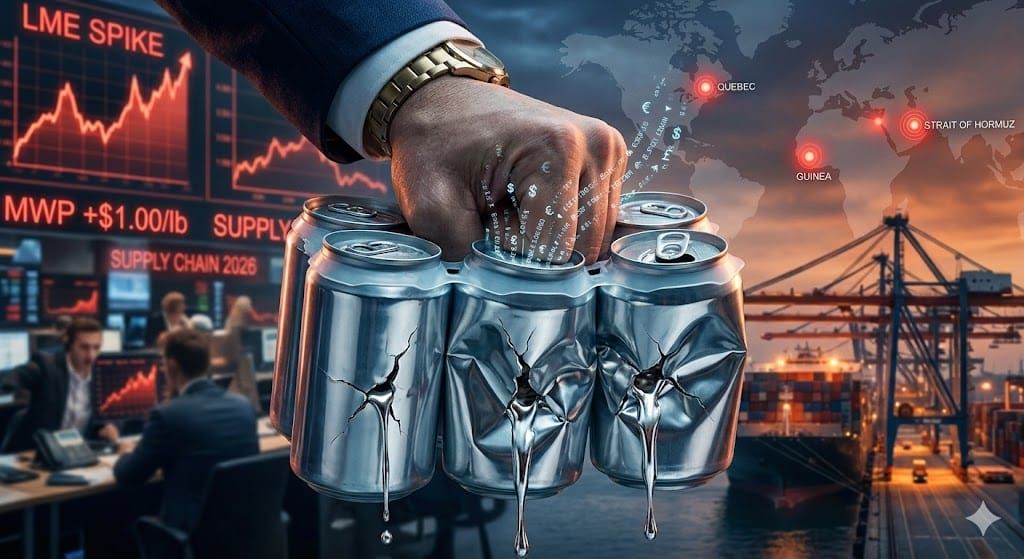
Or: how a rock from Guinea, a smelter in Quebec, and a shipping lane near Iran decided what your six-pack costs this summer.
By Jason Gotcher | BevOpsLogic
Let's get the bad news out of the way: the aluminum market in 2026 is, to use the technical procurement term, a mess. Billet is tight. Midwest Premium is doing its best impression of a SpaceX launch. And somewhere in Geneva, a Mercuria trader is muttering "black swan" into a Bloomberg terminal like it's a wellness mantra.
If you run a beverage business and your product lives inside a 12-ounce aluminum cylinder — congratulations, you're now a geopolitics analyst. Unpaid. No benefits.
What's Actually Happening (The Honest Version)
Strip away the panic cycle and here's the structural picture:
Billet is tightening. Billet is the extruded form that a lot of specialty packaging and equipment depends on, and when billet gets snug, the pressure ripples into can sheet allocation because the same upstream metal units are in play. Converters start triaging customers. Guess who gets triaged first? Not Coca-Cola.
Midwest Premium is elevated. The MWP is the surcharge you pay on top of the LME price for the privilege of having your aluminum physically located in North America rather than, say, vibing in a Rotterdam warehouse. When the MWP runs hot, it usually means physical metal is harder to move than paper metal — a classic tell that the problem is logistics, not mine output.
The Middle East overhang is real. You don't need a specific incident to move this market; you just need the possibility of one to keep premiums bid and shippers cautious. Insurance rates, rerouting, and the general "what if the Strait of Hormuz has a bad Tuesday" tax all show up in your landed cost whether anything actually happens or not.
Forecasters disagree, loudly. One camp sees sustained shortage through 2026. Another sees a surplus and a price crack later in the year. Both camps have spreadsheets. Both camps are on TV. Only one can be right, and neither of them buys your cans.
The BevOpsLogic Take: When the bulls and bears both sound confident, hedge the decision, not the price. Optionality beats conviction every time.
How the Squeeze Actually Hits a Beverage P&L
Here's the part nobody on the news explains, because it's boring and specific and involves the words "tolling agreement."
Your can doesn't come from a smelter. It comes from a canmaker (there are basically three that matter), who buys can sheet from a rolling mill, which buys ingot or slab from a smelter or trader, which may or may not be sourcing from a refinery that turns bauxite into alumina. Five links. Every link has a margin, a contract, and a failure mode.
When the market tightens, the pain doesn't distribute evenly — it pools at whichever link has the least pricing power. That's usually you. Sorry.
Specifically, you'll feel it as:
- Allocation, not outage. Your canmaker won't say "no." They'll say "yes, for 80% of your forecast, and here's the new MWP pass-through clause." Allocation is the shortage.
- Minimums creeping up. SKU proliferation gets expensive in a tight market. Expect your co-packer to "rationalize" your weird seltzer flavor before you do.
- Lead times stretching. Six weeks becomes ten. Ten becomes "let's talk about Q4."
- Contract renewals getting weird. Anything coming up for renewal in 2026 is getting repriced with the canmaker assuming the bull case. Because of course it is.
How Companies Are (Actually) Pivoting
Not every pivot is a good pivot. Here's the triage, ranked from "smart" to "you're going to regret this":
Tier 1 — The Grown-Ups:
- Locking multi-year supply with MWP pass-through caps. Boring. Effective. The people doing this will look like geniuses in October.
- Lightweighting. Shaving grams off the can. Not glamorous, but a 3% metal reduction across a national footprint is real money and it doesn't require a single press release.
- Closed-loop recycling deals. UBC (used beverage can) scrap is the hedge nobody talks about. If you can lock a scrap stream, you've functionally shorted the primary market.
Tier 2 — The "We'll See":
- Regional canmaker diversification. Smart in theory, expensive in practice because qualification runs and printing plate changes aren't free.
- Inventory build ahead of summer. Works if you have the warehouse and the working capital. Doesn't work if you're financing it at current rates.
Tier 3 — The Cope:
- "We're pivoting to glass." Sure you are. Glass is heavier, breaks, costs more to ship, and your entire filling line is calibrated for aluminum. Unless you were already a glass brand, this is a press release, not a strategy.
- "We're pivoting to PET." Same energy. Consumers in premium categories notice. Your margin notices more.
- "We're going to wait it out." Bold. The market rewards this roughly 40% of the time. You are not above average.
The Logic Check
Here's the clean version of the decision tree, because that's what you pay BevOpsLogic for:
- If your contract is locked through 2026: do nothing dramatic, start the 2027 conversation now, and get a scrap stream on the side.
- If your contract renews this year: assume the bull case in your model, negotiate the bear case in your contract, and get MWP caps in writing.
- If you're spot-buying: god help you. Also, call three canmakers this week, not next.
- If you're a startup under 500k cases: your canmaker's allocation meeting is not about you. Find a regional co-packer and build the relationship before you need it.
The Bottom Line
Aluminum in 2026 is a market where the fundamentals are tight, the geopolitics are nervous, and the forecasters are split. That's not a crisis — that's Tuesday in a commodity most beverage operators stopped paying attention to around 2014.
The companies that win the next twelve months won't be the ones who called the price right. They'll be the ones whose contracts don't care what the price does.
Go check yours.
— Jason 🍺