The SKU Squeeze: Every New RTD Flavor Is a Logistical Tax
Adding SKUs feels like growth. The warehouse labor data says otherwise. A first-principles look at Pick-Path Friction and why 500 SKUs costs more than ten times as much to operate as 50.
The SKU Squeeze: Every New RTD Flavor Is a Logistical Tax Your Sales Team Will Never Pay
Here's how the conversation goes. The brand rep walks into the room with a cooler, a pitch deck, and the energy of someone who has never touched a pick-line in their life. Fourteen new SKUs. Limited seasonals, year-rounds, a "platform extension," and something called a "hyper-local collab" that has a six-week shelf life and comes in a case pack of 18 because the brewery's packaging engineer was feeling creative.
"The margins are great," they say.
The margins are not accounting for what happens in your warehouse. They never are.
Your Warehouse Is Not a Magic Box
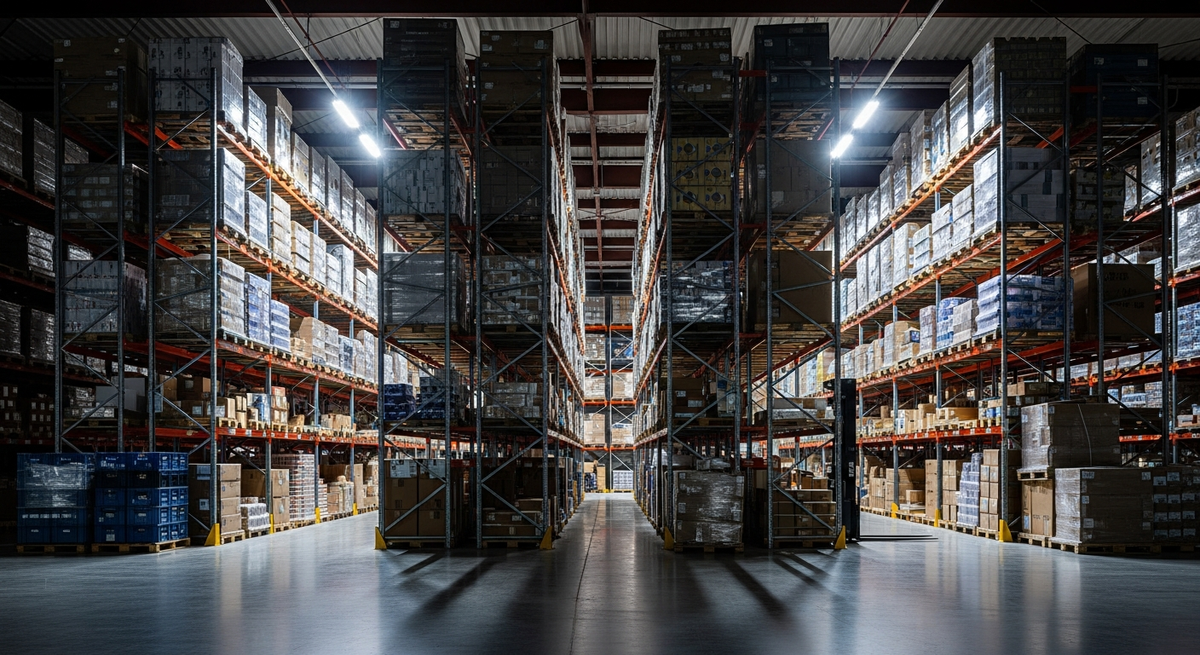
Every SKU you accept doesn't just appear on a shelf. It needs a bin location, a min/max, a replenishment trigger, a velocity classification, and someone to babysit the dunnage pile when the pallet comes in three layers short because the brewery was "trying a new floor stack."
More importantly, every SKU you add stretches your pick-line. And pick-lines do not scale linearly.
Pick-Path Friction is what happens when your pickers spend more time walking the warehouse than actually picking product. At 50 SKUs, your team runs a clean loop — product slotted by velocity, zones organized, errors rare. Add 450 SKUs across a portfolio that looks like someone put Canva on a dare, and that same 10-line order now takes three times the travel distance.
That distance is labor. Labor costs money. The brand rep is not there to help pay for it.
The Numbers, Since Apparently We Have to Show Our Work
| SKU Count | Avg Pick Travel (10-line order) | Mispick Rate | Labor Premium vs. 50-SKU baseline |
|---|---|---|---|
| 50 | ~200 ft | ~0.5% | Baseline |
| 150 | ~380 ft | ~0.8% | +40% |
| 300 | ~520 ft | ~1.2% | +85% |
| 500 | ~700 ft | ~1.8% | +150-180% |
Ten times the SKUs. Two and a half times the labor cost — if you're disciplined about slotting. If you're not, it's worse.
Let's also talk about mispicks, which is the polite term for "sending the wrong product to an account and then spending 40 minutes on the phone with their buyer explaining why they received Mango Habanero Seltzer instead of their standing order of domestic 30-packs." At 500 SKUs, your mispick rate nearly quadruples. Every one of those is a credit memo, a relationship conversation, and a driver who had to make an unplanned stop.
Who Actually Pays This Tax?
Not the supplier. The supplier's invoice is the same whether your pick-path is 200 feet or 800 feet. They don't see the overtime. They don't see the out-of-code product that got buried under three new launches because nobody touched the back of the slot for six weeks. They definitely don't see the warehouse manager's face when the Q4 limited-edition collab pallet arrives with 72 hours of promotional sell-by runway.
You pay it. Your drivers pay it. Your pick team pays it. And then, eventually, your best accounts pay it when service starts slipping because your operation is running hot trying to manage a portfolio that grew faster than your systems.
The Fix: Velocity Slotting and Saying No More Often
Velocity-based slotting is not glamorous. It is, however, the single highest-ROI warehouse project most mid-tier distributors are not doing consistently. Put your fastest movers at the front of the pick-line, closest to the dock. Revisit the slot plan quarterly when velocities shift — not annually when someone complains.
Full-cost SKU contribution modeling is the other half. Assign every SKU its actual operational overhead: pick-path allocation, error-correction cost, slotting complexity. When the $2.40 gross margin on a six-pack of artisanal craft seltzer carries $1.80 in operational overhead, the math on that placement collapses immediately.
The most profitable distributors in this industry are not the ones that say yes to everything. They're the ones that have a framework for saying no — and can show the brand rep the spreadsheet that explains why.
Build the spreadsheet. Laminate it. Bring it to every new SKU meeting.