Distribution Intel May 18: RNDC's Continued Unwind, RTD Cocktails Hold Ground, Legacy Brands Fall
RNDC's exit accelerates middle-tier consolidation across spirits. RTD cocktails outperform as total bev-alc weakens. Jones Soda posts 194% growth on Fallout collab. Muscle Milk reformulates for mainstream. Pabst kills Schlitz after 175 years.
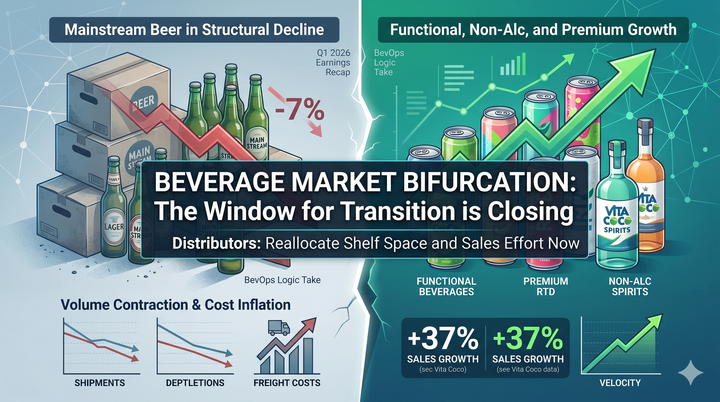
The week is divided into two narratives. One is structural: RNDC's territories are still moving, RTD spirits are still growing despite near-term softness, and regional distributors are picking up the pieces and consolidating power. The other is symbolic: Pabst put Schlitz on permanent hiatus, Jones Soda posted near-200% growth on a video game tie-in, and Muscle Milk is abandoning gym-rat positioning for "protein for all." The through-line is that wholesale beverage distribution is no longer about defending legacy shelf space. It's about finding velocity where it actually exists.
Story 1: RNDC's Continued Exit Scatters Spirits Brands; Middle-Tier Consolidation Accelerates
Source: BevNET, May 15, 2026
Republic National Distributing Company continues to wind down operations across the country, scattering independent and major spirits brands to new distribution partnerships. Regional distributors are absorbing RNDC territories, consolidating market control and expanding their category depth in wine and spirits. The exits have created a window for emerging RTD brands to push into new geographic markets from Wisconsin to Southern California.
BevOps Logic Take: RNDC's exit is now a feature, not a crisis. This is the second wavethe first moved the biggest accounts, the second is mopping up the mid-tier. For regional beverage distributors, the immediate opportunity is spirits portfolio rationalization. You're inheriting RNDC accounts with bloated wine lists and legacy relationships. Cull aggressively. The distributors winning the consolidation game are those who cut SKU count to 40-50 core wines, hold margin, and use that freed-up sales time to spec RTD cocktails and functional spirits adjacencies. For suppliers, this is your window to pitch distributors who just inherited territory. They need new relationships, not just inherited ones. The brands getting picked up are those with clear positioning and demonstrable velocity. Legacy positioning gets cut.
Story 2: RTD Cocktails Outperform Total Bev-Alc as Category Softens Slightly
Source: Brewbound, May 15, 2026
Total beverage-alcohol dollar sales continued to decline in the latest two-week period, though the decline moderated slightly from prior weeks. RTD cocktails remained the standout category, though even RTD saw a sales dip in the same period, suggesting market saturation is beginning to pressure even the strongest subsegment.
BevOps Logic Take: RTD cocktails are no longer a growth category. They're a market-share category. The headline is that RTDs outperformed in a declining market, but the detail matters: RTDs themselves saw sales decline. What's happening is velocity redistribution. New RTD brands are taking share from established ones, and the overall category is hitting a saturation wall where every incremental dollar of RTD growth comes from somewhere else (beer, spirits, wine, ready-to-drink functional). For distributors, this means the RTD play is now about brand curation, not category expansion. You can't grow the RTD section anymore. You manage it. The winning move is rotating slower SKUs out of the category, not adding to it. For suppliers, the implication is direct: if your RTD cocktail doesn't have a clear functional differentiation, flavor story, or channel lock, you are competing purely on price. Your margin is negative. The brands surviving RTD saturation are those with either premium positioning or occasion-specific usage (pre-game, work lunch, wellness ritual).
Story 3: Jones Soda Posts 194% Q1 Growth on Fallout Video Game Collaboration
Source: BevNET, May 15, 2026
Jones Soda reported Q1 2026 net revenue of $12.4 million, a 193.9% year-over-year increase from $4.2 million the prior year. The growth was driven primarily by co-branded Fallout beverages tied to the Fallout video game franchise, which generated significant velocity at retail and online. The collaboration expanded Jones Soda's distribution footprint and consumer awareness beyond its regional base.
BevOps Logic Take: Jones Soda's 194% growth is not a business story. It's a marketing story. This is a one-time collab revenue bump. The question every distributor should be asking is: after Fallout, what is Jones Soda's base business? Does the brand hold the new distribution it earned? Does consumer repeat exist, or is it an event? For distributors, the short-term play is obvious: capitalize on Fallout velocity to reset shelf position and negotiate better cooperatives with retailers. Get the brand on more doors and in more facings while the consumer interest is live. But don't build your growth forecast on Jones Soda becoming a $50M revenue business. The long-term play is whether the brand can hold customers once the Fallout moment passes. For suppliers in niche or emerging categories, the Jones Soda moment is a reminder: earned-media velocity through IP partnerships can move more product in three months than traditional sales effort moves in a year. If you have an IP asset (entertainment, gaming, lifestyle brand) that aligns with your beverage, the ROI on that partnership is worth the negotiation friction.
Story 4: Muscle Milk Reformulates RTD Line with Cleaner Labels, Targets Mainstream Protein Consumer
Source: BevNET, May 15, 2026
Muscle Milk is undergoing its most significant reformulation and packaging redesign in years, repositioning from gym-exclusive positioning to "protein for all" messaging. The brand has moved to ultrafiltered milk as its protein base and stripped ingredient lists to appeal to mainstream consumers beyond the fitness category. The shift signals a pivot away from core athletic consumers toward occasion-based protein consumption.
BevOps Logic Take: Muscle Milk's reformulation is a category maturation play. The gym-rat positioning worked when protein RTD was a niche category. Now that protein beverages are mainstream and competing across dairy, plant-based, and functional segments, the brand is chasing volume over margin. The implication is clear: Muscle Milk is abandoning its original positioning because that positioning is commoditized. For distributors carrying protein RTDs, this is a signal to audit your portfolio. If you have three protein brands competing for the same mainstream consumer occasion, one of them is not going to survive the next two resets. Muscle Milk's "protein for all" positioning will fight for the same shelf space as Fairlife Core Power, Premier Protein, and store brand protein. You need to know which one has velocity in your geography and which one is being held as a legacy relationship. For suppliers, the message is that niche positioning is a liability once your category hits scale. The brands winning in protein are those with either functional differentiation (collagen, probiotics, MCTs) or occasion lock (post-workout, meal replacement, coffee creamer alternative). Plain protein is a margin race to zero.
Story 5: Pabst Puts Schlitz on Indefinite Hiatus; 175-Year-Old Brand Production Stops
Source: Brewbound, May 15, 2026
Pabst Brewing Company has discontinued production of Schlitz, the 175-year-old light beer brand, placing it on indefinite hiatus. The move reflects ongoing volume pressures in the mainstream beer segment and Pabst's decision